


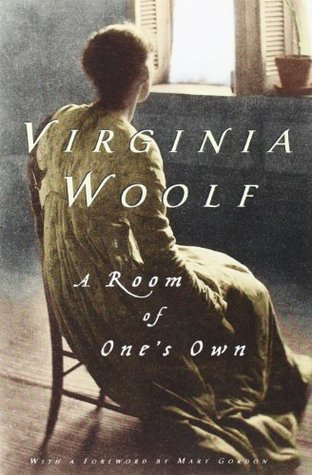
This is an extended essay put together from 2 letters that Virginia Woolf wrote in response to being asked to speak about ‘Women in fiction’.
We see Woolf’s signature stream of consciousness narrative or how Woolf puts it herself, rambling. Thoughts are fleeting in Woolf’s writing. She is always chasing them and taking us along on the ride. Some thoughts do escape her. I found it amusing how at the brink of a groundbreaking realization, she would shift her focus to bread or tipping a waiter.
There is a lot of anecdotal and satirical content in this lengthy essay. In this conversational and deeply engaging masterpiece, Woolf recognizes that fiction is not just a result of genius. It is also a result of material circumstances. She comments on and compares many female writers- Jane Austen, Aphra Ben and Charlotte Bronte.
Woolf embarks on a quest to find answers to these questions:
1. What effect does financial status have on fiction ?
2. What conditions are necessary for the creation of works of art ?
Following are her theoretical conclusions:
- Money
- Privacy
- Time
Bear in mind that Woolf wrote this essay in 1929. A time when women did not have many career options and had just gotten the right to vote in England. While women still fall victim to gender pay gap discrimination, not to mention the financial penalty we incur as a result of embracing motherhood, we cannot claim to be, as Woolf puts it, the “impoverished gender”.
Woolf talks in length about having the financial freedom to nurture one’s creativity. Woolf herself benefitted from an aunt who left her a handsome annual salary after she passed away. It could be detrimental to your creativity, to expect it to pay your bills. Unless you have a trust fund, I would suggest you keep your day job. Do not burden your creativity with the responsibility to pay for your life, especially when you are just starting out.
Privacy is needed to lay bare one’s thoughts and impressions. To get a glimpse of these fleeting thoughts and then to weave them in to something more tangible, one would need the proverbial ‘Room of one’s own’. Uninterrupted quiet time is an elusive concept for women, especially when they are in charge of domestic duties.
This takes us back to the need for financial independence. Privacy and leisure are not privileges of the poor or the financially dependent. Financial freedom is the truest form of freedom. Woolf deals with not just gender discrimination but also with class discrimination. She notes that most of the established artist came from an affluent background. She sees a direct correlation between people with access and resources and the ability to be inspired and create masterpieces.
In her findings, she not only discovers the conditions that sustain creativity but she also chances upon the reasons that make it necessary for the marginalized to find their voice in art.
Men write a lot about woman. What men write about woman is all over the place and contradictory. It mythologizes women. This has led to women being included in artwork as supporting cast. They are reduced to one-dimensional characters. The female experience is marginalized due to this.
“Mirrors are essential to all violent and heroic action. That is why Napoleon and Mussolini both insist so emphatically upon the inferiority of women, for it they were not inferior, they would cease to enlarge.
The looking glass vision is of supreme importance because it charges the vitality; it stimulates the nervous system.“
In insisting upon the inferiority of women, men gain a sense of self-aggrandizing confidence. While this confidence has led to significant inventions and glory, we must look deeper in to detrimental effect it has on the brilliance and creativity of the perceived inferior gender. We are in to 2,00,000 year of existence of human race and are still debating the equality of genius of the two genders.
“The life of the average Elizabethan woman must be scattered about somewhere, could one collect it and make a book of it.
When one reads of a witch being ducked, of a woman possessed by devils, of a wise woman selling herbs, or even of a remarkable man who had a mother, then I think we are on the track of a lost novelist, a suppressed port, of some mute and inglorious Jane Austen.“
Woolf imagines if Shakespeare were to have a sister, would she be able to create exquisite literature as he did . The rationale here is, if a woman existed with the same means and talent as Shakespeare, would she be as great a writer as Shakespeare. She pragmatically projects this fictional sister’s life to discern her potential as an artist. She would most likely get married off.
If she were able to somehow avoid a family life, how successful would she be in making it in London on her own? She would not have been able to show up at theaters looking for a job. She certainly would not be able to network as Shakespeare did. All these extenuating circumstances would have kept her from creating art.
“To Jane Austen there was something discreditable in writing Pride and Prejudice.
For masterpieces are not single and solitary births; they are the outcome of many years of thinking in common, of thinking by the body of the people, so that the experience of the mass is behind the single voice.“
It takes generations worth of effort to invent the wheel. Jane Austen needed inspiration too. She was self-conscious of her work and sought to hide behind a pen name . Even Virginia Woolf was apprehensive about publishing this essay and expected backlash.
Even if you think your writing is no good, write. Write a lot and write often. Write for the joy of it. Don’t expect a reward or validation in return. Believe your words are worthy of other’s time. Write without hate, bitterness, fear, protest or preaching. Bitterness will contaminate your art.
Write androgynously. Virginia Woolf states that a mind that adheres to a singular gendered structure is not favorable for creativity.
“Don’t lead with your sex or try to prove a point with your writing related to your sex.”
We have both masculine and feminine in our minds. Writing from a place of balance will make you a good writer and give your art a chance to thrive. Woolf credits Shakespeare to being dextrous at this skill.
At just over a 100 pages this book has a wealth of wisdom and philosophy. The prose flows deftly from one finding to the other.
 Book Broad